Optimalisasi Mixed Light dalam Fotografi Produk: Workshop untuk Teman Tuli Surakarta
Article Sidebar
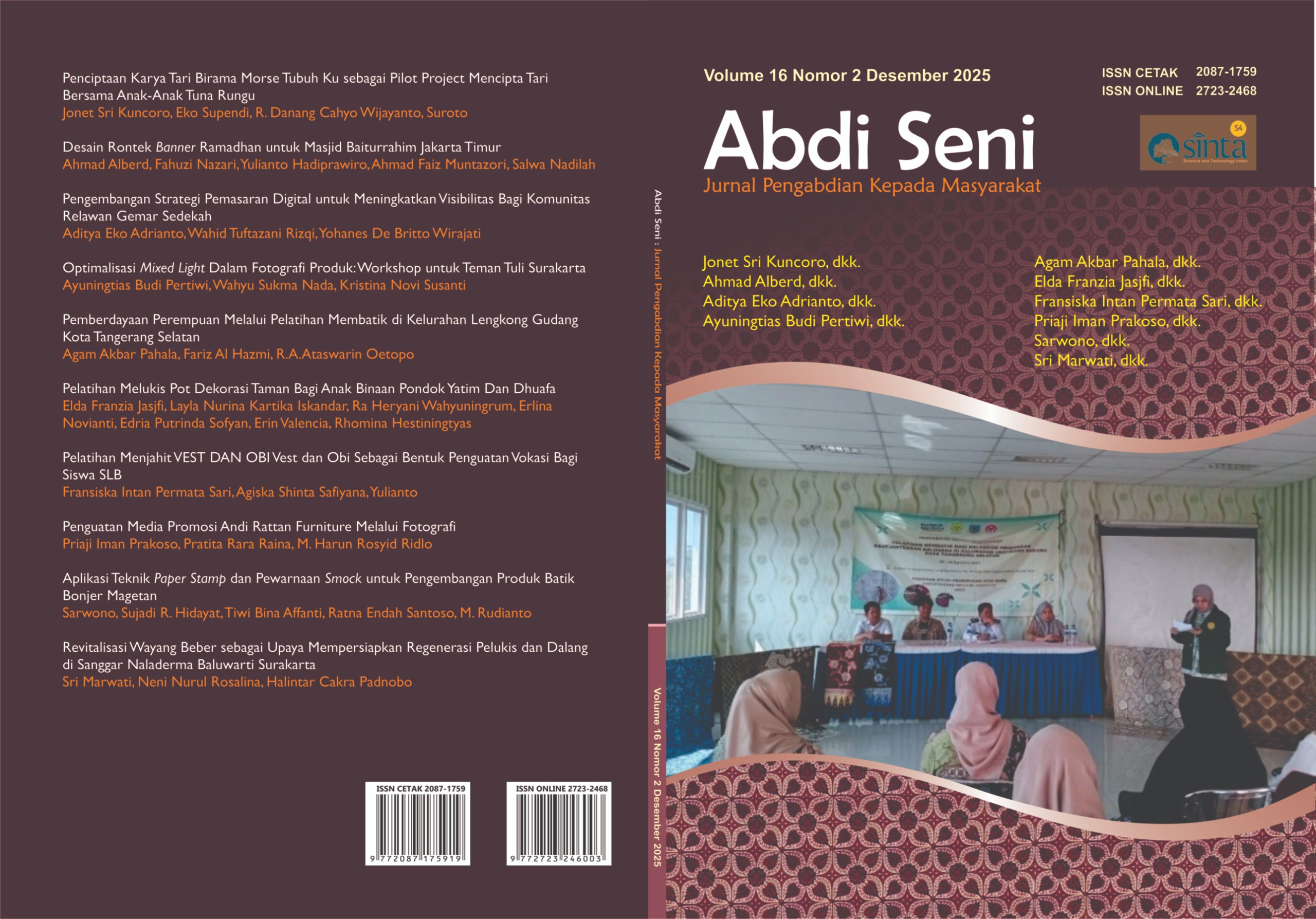
Main Article Content
Abstract
Product photography training is one of the relevant empowerment efforts to support the potential of the deaf community in the era of the creative economy. Deaf individuals have advantages in the visual field; however, limited access to practical training often becomes an obstacle to selfdevelopment. This activity aims to optimize the use of mixed light techniques, which combine natural light and artificial light, in product photography practices through an inclusive workshop. The method used was direct practice at the DPC Gerkatin Surakarta location with a visual approach and the use of sign language to ensure full accessibility for the participants. The workshop was held on May 24, 2025, with a total of 15 participants. The training materials included basic product photography, lighting principles, and hands-on practice using mixed light techniques. The results of this activity showed an increase in participants' understanding of lighting techniques and their ability to produce product photos suitable for promotional purposes. This workshop also improved participants' self-confidence and opened opportunities for skill development in the creative economy sector. The activity proved that an inclusive and practicebased photography approach can be an effective means of empowerment for the deaf community.
Keywords: deaf community, product photography, mixed light
Downloads
Article Details

This work is licensed under a Creative Commons Attribution-ShareAlike 4.0 International License.
License and Copyright Agreement
In submitting the manuscript to the journal, the authors certify that:
- Their co-authors authorize them to enter into these arrangements.
- The work described has not been formally published before, except as an abstract or part of a published lecture, review, thesis, or overlay journal. Please also carefully read Abdi Seni's Posting Your Article Policy at https://jurnal.isi-ska.ac.id/index.php/abdiseni/about/editorialPolicies#peerReviewProcess
- That it is not under consideration for publication elsewhere,
- That its publication has been approved by all the author(s) and by the responsible authorities – tacitly or explicitly – of the institutes where the work has been carried out.
- They secure the right to reproduce any material already published or copyrighted elsewhere.
- They agree to the following license and copyright agreement.
Copyright
Authors who publish with Abdi Seni agree to the following terms:
- Authors retain copyright and grant the journal right of first publication with the work simultaneously licensed under a Creative Commons Attribution License (CC BY-SA 4.0) that allows others to share the work with an acknowledgment of the work's authorship and initial publication in this journal.
- Authors can enter into separate, additional contractual arrangements for the non-exclusive distribution of the journal's published version of the work (e.g., post it to an institutional repository or publish it in a book), with an acknowledgment of its initial publication in this journal.
- Authors are permitted and encouraged to post their work online (e.g., in institutional repositories or on their website) before and during the submission process, as it can lead to productive exchanges and earlier and greater citation of published work.
Licensing for Data Publication
Abdi Seni uses a variety of waivers and licenses that are specifically designed for and appropriate for the treatment of data:
- Open Data Commons Attribution License, http://www.opendatacommons.org/licenses/by/1.0/ (default)
- Creative Commons CC-Zero Waiver, http://creativecommons.org/publicdomain/zero/1.0/
- Open Data Commons Public Domain Dedication and Licence, http://www.opendatacommons.org/licenses/pddl/1-0/
Other data publishing licenses may be allowed as exceptions (subject to approval by the editor on a case-by-case basis). They should be justified with a written statement from the author, which will be published with the article.
Open Data and Software Publishing and Sharing
The journal strives to maximize the replicability of the research published in it. Authors are thus required to share all data, code, or protocols underlying the research reported in their articles. Exceptions are permitted but must be justified in a written public statement accompanying the article.
Datasets and software should be deposited and permanently archived in inappropriate, trusted, general, or domain-specific repositories (please consult http://service.re3data.org and/or software repositories such as GitHub, GitLab, Bioinformatics.org, or equivalent). The associated persistent identifiers (e.g., DOI or others) of the dataset(s) must be included in the article's data or software resources section. Reference(s) to datasets and software should also be included in the article's reference list with DOIs (where available). Where no domain-specific data repository exists, authors should deposit their datasets in a general repository such as ZENODO, Dryad, Dataverse, or others.
Small data may also be published as data files or packages supplementary to a research article. However, the authors should prefer a deposition in data repositories in all cases.