Teachers' perceptions of visual arts creativity practices in elementary schools in Indonesia: a study of aesthetic habitus
Article Sidebar
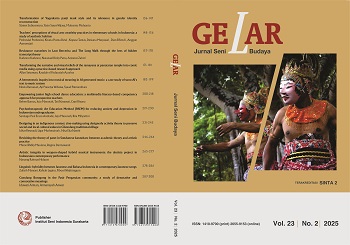
Main Article Content
Abstract
The background comes from the teaching practice experience of students in the elementary school education program, which mainly focuses on core subjects. Although the visual arts are not considered a core subject in elementary schools, they still play an important role in helping students grow and develop by raising awareness about artistic practices. The goal of this article is to explain what teachers think about creativity in visual arts learning during their teaching practices, as seen through the perspective of students in the school teacher education department. The study uses a qualitative approach. To collect data, the researchers conducted interviews, made observations, and reviewed documents. The data was analyzed using the Miles & Huberman method, and the results were presented in both written and table formats. The findings show that teaching practices in elementary schools, done by students in the education program, give them hands-on experience as future teachers. They use aesthetic ideas as a way to connect art and beauty in daily life. The students create art that fits their home environments. Also, aesthetics are included in habitus practices, which are internalized as structured ways of seeing, judging, feeling, and acting towards the subjects they study.
Downloads
Article Details

This work is licensed under a Creative Commons Attribution-ShareAlike 4.0 International License.
Copyright
Authors who publish with Gelar: Jurnal Seni Budaya agrees to the following terms:
- Authors retain copyright and grant the journal right of first publication with the work simultaneously licensed under a Creative Commons Attribution License (CC BY-SA 4.0) that allows others to share the work with an acknowledgment of the work's authorship and initial publication in this journal.
- Authors are able to enter into separate, additional contractual arrangements for the non-exclusive distribution of the journal's published version of the work (e.g., post it to an institutional repository or publish it in a book), with an acknowledgment of its initial publication in this journal.
- Authors are permitted and encouraged to post their work online (e.g., in institutional repositories or on their website) prior to and during the submission process, as it can lead to productive exchanges, as well as earlier and greater citation of published work.
References
[1] J. Li and Y. Qi, “Arts education and its role in enhancing cognitive development: A quantitative study of critical thinking and creativity in higher education,” Cogn. Dev., vol. 74, p. 101544, 2025, doi: 10.1016/j.cogdev.2025.101544.
[2] C. Zhang and B. Jia, “Enriching STEAM education with visual art: education benefits, teaching examples, and trends,” Discov. Educ., vol. 3, no. 1, p. 247, 2024, doi: 10.1007/s44217-024-00354-w.
[3] H. Song, S. Chen, and M. Mustafa, “Creativity, Practical Ability, Self‐Identity: Public Art Practice with Primary School Students in China,” Int. J. Art Des. Educ., vol. 44, no. 1, pp. 132–148, 2025, doi: 10.1111/jade.12531.
[4] M. Oubibi and K. Hryshayeva, “Effects of virtual reality technology on primary school students’ creativity performance, learning engagement and mental flow,” Educ. Inf. Technol., vol. 29, no. 17, pp. 22609–22628, 2024, doi: 10.1007/s10639-024-12766-0.
[5] D. Dumitru, “Creating meaning. The importance of Arts, Humanities and Culture for critical thinking development,” Stud. High. Educ., vol. 44, no. 5, pp. 870–879, 2019, doi: 10.1080/03075079.2019.1586345.
[6] L. Soyland, I. H. Hoibo, C. Groth, and P. Seitamaa‐Hakkarainen, “Explorative Interaction with Materiality in Norwegian Primary School Makerspaces from the Perspective of Arts and Crafts Education,” International Journal of Art & Design Education. Wiley Online Library, 2025, doi: 10.1111/jade.12547.
[7] Y. Xie, S. Zhou, and O. D. Apuke, “The Effect of Interactive Television-Based Visual Arts and Expressive Arts Therapy on the Critical Thinking Skills of School Children that Survived Abduction,” J. Asian Afr. Stud., vol. 60, no. 3, pp. 1782–1793, 2025, doi: 10.1177/00219096231200597.
[8] S. K. Y. Leung, J. Wu, and T. H. Ho, “Early childhood visual arts education: Teachers’ content knowledge, pedagogical content knowledge, and challenges,” Asia-Pacific Educ. Res., vol. 34, no. 1, pp. 351–363, 2025, doi: 10.1007/s40299-024-00859-w.
[9] D. Serig, “A conceptual structure of visual metaphor,” Stud. Art Educ., vol. 47, no. 3, pp. 229–247, 2006, doi: 10.1080/00393541.2006.11650084.
[10] E. K. Kallio, L. Mononen, and T. Ek, “Holistic wisdom education: Towards transformational creativity,” in Transformational creativity: Learning for a better future, Springer, 2024, pp. 169–182. doi: 10.1007/978-3-031-51590-3_12
[11] N. Kim, “A History of Design Theory in Art Education,” J. Aesthetic Educ., vol. 40, no. 2, pp. 12–28, 2006, doi: 10.2307/4140227.
[12] A. E. Green, R. E. Beaty, Y. N. Kenett, and J. C. Kaufman, “The process definition of creativity,” Creat. Res. J., vol. 36, no. 3, pp. 544–572, 2024, doi: 10.1080/10400419.2023.2254573.
[13] R. Potocnik and J. Rapus Pavel, “Visual arts teachers making art–a qualitative study of strengthening the emotional and social skills Through visual arts activities,” Cogent Educ., vol. 11, no. 1, p. 2372157, 2024, doi: 10.1080/2331186X.2024.2372157.
[14] E. Zimmerman, “Reconceptualizing the role of creativity in art education theory and practice,” Stud. Art Educ., vol. 50, no. 4, pp. 382–399, 2009, doi: 10.1080/00393541.2009.11518783.
[15] A. Abraham, “Why the standard definition of creativity fails to capture the creative act,” Theory Psychol., vol. 35, no. 1, pp. 40–60, 2025, doi: 10.1177/09593543241290232.
[16] A. J. Cropley, “Defining and measuring creativity: Are creativity tests worth using?,” Roeper Rev., vol. 23, no. 2, pp. 72–79, 2000, doi: 10.1080/02783190009554069.
[17] M. Sun, M. Wang, and R. Wegerif, “Using computer‐based cognitive mapping to improve students’ divergent thinking for creativity development,” Br. J. Educ. Technol., vol. 50, no. 5, pp. 2217–2233, 2019, doi: 10.1111/bjet.12825.
[18] J. Zeng, H. Yan, and H. Zhang, “How Classroom Curiosity Affects College Students’ Creativity?,” Educ. Sci., vol. 15, no. 9, p. 1101, 2025, doi: 10.3390/educsci15091101.
[19] A. Nurakenova and K. Nagymzhanova, “A study of psychological features related to creative thinking styles of university students,” J. Psycholinguist. Res., vol. 53, no. 1, p. 1, 2024, doi: 10.1007/s10936-024-10042-3.
[20] T. I. Lubart, “Models of the creative process: Past, present and future,” Creat. Res. J., vol. 13, no. 3–4, pp. 295–308, 2001, doi: 10.1207/S15326934CRJ1334_07.
[21] T. Brandt, M. Dieterich, and D. Huppert, “Human senses and sensors from Aristotle to the present,” Front. Neurol., vol. 15, p. 1404720, 2024, doi: 10.3389/fneur.2024.1404720.
[22] S. Snyder and T. Fisk, “A National Survey of Teaching Artists Working in Schools: Background, Preparation, Efficacy and School Experiences.,” J. Res. Educ., vol. 26, no. 1, pp. 1–30, 2016.
[23] M. M. Musa and R. Kamal, “Ekstrakulikuler art painting dalam meningkatkan kreativitas siswa pada kompetensi pembelajaran abad 21 di sekolah dasar,” Madako Elem. Sch., vol. 1, no. 2, pp. 118–131, 2022, doi: 10.56630/mes.v1i2.59.
[24] F. Kong, “Evaluation model of adaptive teaching ability of college art teachers,” Int. J. Emerg. Technol. Learn., vol. 15, no. 9, pp. 143–155, 2020, doi: 10.3991/ijet.v15i09.14031.
[25] J. K. Bizley and Y. E. Cohen, “The what, where and how of auditory-object perception,” Nat. Rev. Neurosci., vol. 14, no. 10, pp. 693–707, 2013, doi: 10.1038/nrn3565.
[26] S. Wa-Mbaleka, “The Researcher as an Instrument,” in Computer Supported Qualitative Research: New Trends on Qualitative Research (WCQR2019), 2020, pp. 33–41. doi: 10.1007/978-3-030-31787-4_3
[27] N. Osborne and D. Grant-Smith, “In-Depth Interviewing,” in Methods in Urban Analysis, 2021, pp. 105–125. doi: 10.1007/978-981-16-1677-8_7
[28] C. Lord, “Shattering the Myth of the Passive Spectator: Entrepreneurial Efforts to Define and Enhance Participation in‘ Non-Participatory’ Arts,” Artivate, vol. 1, no. 1, pp. 35–49, 2012, doi: 10.1353/artv.2012.0004.
[29] F. Hanell and P. J. Severson, “An open educational resource for doing netnography in the digital arts and humanities,” Educ. Inf., vol. 39, no. 2, pp. 155–172, 2023, doi: 10.3233/EFI-230024.
[30] G. Mecacci and W. F. G. Haselager, “Stimulating the self: The influence of conceptual frameworks on reactions to deep brain stimulation,” AJOB Neurosci., vol. 5, no. 4, pp. 30–39, 2014, doi: 10.1080/21507740.2014.951776.
[31] G. L. Poerio, H. M. Kondo, and B. C. J. Moore, “Sensing and feeling: an overview,” Philos. Trans. R. Soc. B, vol. 379, no. 1908, p. 20230242, 2024, doi: 10.1098/rstb.2023.0242.
[32] E. Pitt and D. Carless, “Signature feedback practices in the creative arts: integrating feedback within the curriculum,” Assess. Eval. High. Educ., vol. 47, no. 6, pp. 817–829, 2022, doi: 10.1080/02602938.2021.1980769.
[33] A. H. Goldman, “Aesthetic qualities and aesthetic value,” J. Philos., vol. 87, no. 1, pp. 23–37, 1990, doi: 10.2307/2026797.
[34] I. Stigliani and D. Ravasi, “The shaping of form: Exploring designers’ use of aesthetic knowledge,” Organ. Stud., vol. 39, no. 5–6, pp. 747–784, 2018, doi: 10.1177/0170840618759813.
[35] Z. Wu, “The free aesthetics of Eastern philosophy, the artistic creation and the influence of Eastern philosophy on contemporary visual art,” Trans/Form/Ação, vol. 48, no. 5, p. e025056, 2025, doi: 10.1590/0101-3173.2025.v48.n5.e025056.