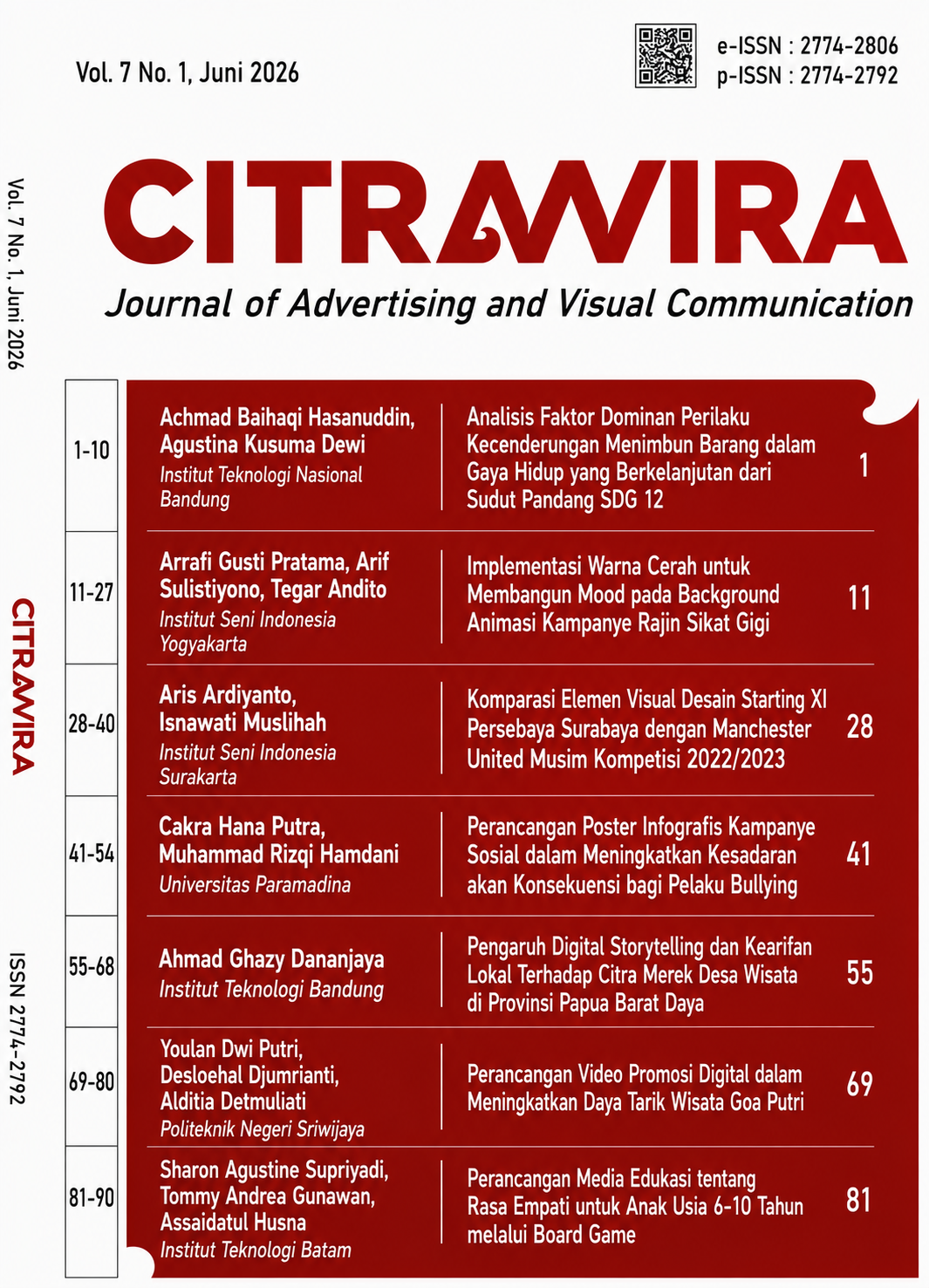
Pengaruh Digital Storytelling dan Kearifan Lokal Terhadap Citra Merek Desa Wisata di Provinsi Papua Barat Daya
DOI:
https://doi.org/10.33153/citrawira.v7i1.8260Keywords:
citra merek, desa wisata, digital storytelling, kearifan lokal, papua barat dayaAbstract
Penelitian ini bertujuan untuk mengukur pengaruh konten digital storytelling dan nilai kearifan lokal terhadap citra merek desa wisata di Provinsi Papua Barat Daya. Meskipun provinsi ini memiliki keragaman destinasi mulai dari status Rintisan hingga Maju, kesenjangan promosi digital antarwilayah masih menjadi kendala utama. Menggunakan pendekatan kuantitatif eksplanatori, penelitian ini melibatkan survei terhadap 200 responden yang mengakses konten digital terkait 30 desa wisata di wilayah Maybrat, Raja Ampat, Sorong, dan Tambrauw. Analisis data menggunakan Regresi Linier Berganda dan Bayesian ANOVA dengan bantuan SPSS. Hasil penelitian menunjukkan bahwa digital storytelling (X1) dan integrasi nilai kearifan lokal (X2) berpengaruh signifikan dan positif terhadap citra merek desa wisata (Y). Temuan ini mengimplikasikan bahwa desa wisata kategori Rintisan dapat mempercepat peningkatan statusnya dengan mengadopsi strategi narasi budaya digital yang telah sukses diterapkan oleh desa wisata kategori Maju untuk membangun identitas destinasi yang kuat. Secara kuantitatif, kontribusi kearifan lokal (b = 0,482) tercatat sedikit lebih besar daripada digital storytelling (b = 0,415), dan model gabungan kedua variabel memperoleh dukungan bukti yang sangat menentukan (BF10 lebih dari 100).
Downloads
References
Alexander, B. (2011). The new digital storytelling: Creating narratives with new media. Praeger. https://books.google.co.id/books?id=TheNewDigitalStorytelling
Ayatrohaedi. (1986). Kepribadian budaya bangsa (local genius). Pustaka Jaya.
Badan Pusat Statistik Provinsi Papua Barat. (2025). Provinsi Papua Barat Daya dalam angka 2025. BPS Provinsi Papua Barat. https://papuabarat.bps.go.id
Baloglu, S., & McCleary, K. W. (1999). A model of destination image formation. Annals of Tourism Research, 26(4), 868–897. https://doi.org/10.1016/S0160-7383(99)00030-4
Bassano, C., Barile, S., Piciocchi, P., Spohrer, J. C., Iandolo, F., & Fisk, R. (2019). Storytelling about places: Tourism marketing in the digital age. Cities, 87, 10–20. https://doi.org/10.1016/j.cities.2018.12.025
Blain, C., Levy, S. E., & Ritchie, J. R. B. (2005). Destination branding: Insights and practices from destination management organizations. Journal of Travel Research, 43(4), 328–338. https://doi.org/10.1177/0047287505274646
Buhalis, D. (2020). Technology in tourism-from information communication technologies to eTourism and smart tourism towards ambient intelligence tourism: A perspective article. Tourism Review, 75(1), 267–272. https://doi.org/10.1108/TR-06-2019-0258
Burgess, J. (2006). Hearing ordinary voices: Cultural studies, vernacular creativity and digital storytelling. Continuum, 20(2), 201–214. https://doi.org/10.1080/10304310600641737
Cohen, E. (1988). Authenticity and commoditization in tourism. Annals of Tourism Research, 15(3), 371–386. https://doi.org/10.1016/0160-7383(88)90028-X
Couldry, N. (2008). Mediatization or mediation? Alternative understandings of the emergent space of digital storytelling. New Media & Society, 10(3), 373–391. https://doi.org/10.1177/1461444808089414
Ekinci, Y. (2003). From destination image to destination branding: An emerging area of research. Journal of Vacation Marketing, 9(1), 21–24. https://doi.org/10.1177/135676670300900102
Gartner, W. C. (1994). Image formation process. Journal of Travel & Tourism Marketing, 2(2–3), 191–216. https://doi.org/10.1300/J073v02n02_12
Geertz, C. (1973). The interpretation of cultures: Selected essays. Basic Books.
Geriya, I. W. (2000). Pariwisata dan dinamika kebudayaan lokal. Dinas Kebudayaan Propinsi Bali.
Green, M. C., & Brock, T. C. (2000). The role of transportation in the persuasiveness of public narratives. Journal of Personality and Social Psychology, 79(5), 701–721. https://doi.org/10.1037/0022-3514.79.5.701
Haba, J. (2007). Revitalisasi kearifan lokal: Studi resolusi konflik di Kalimantan Barat, Maluku dan Poso. ICIP.
Hair, J. F., Black, W. C., Babin, B. J., & Anderson, R. E. (2014). Multivariate data analysis (7th ed.). Pearson Education.
Hankinson, G. (2004). Relational network brands: Towards a conceptual model of place brands. Journal of Vacation Marketing, 10(2), 109–121. https://doi.org/10.1177/135676670401000202
Hanna, S., & Rowley, J. (2008). An integrated model of destination branding. International Journal of Contemporary Hospitality Management, 23(3), 458-476. https://doi.org/10.1108/09596111111122532
Jeffreys, H. (1961). Theory of probability (3rd ed.). Oxford University Press.
Keller, K. L. (1993). Conceptualizing, measuring, and managing customer-based brand equity. Journal of Marketing, 57(1), 1–22. https://doi.org/10.1177/002224299305700101
Keller, K. L. (2013). Strategic brand management: Building, measuring, and managing brand equity (4th ed.). Pearson.
Kemenparekraf. (2021). Pedoman desa wisata maju dan mandiri. Kementerian Pariwisata dan Ekonomi Kreatif Republik Indonesia. https://kemenparekraf.go.id
Kemenparekraf. (2024). Rencana strategis kementerian pariwisata dan ekonomi kreatif 2020-2024 (Revisi). Kemenparekraf. https://kemenparekraf.go.id/transparansi/rencana-strategis
Keraf, A. S. (2010). Etika lingkungan hidup. Penerbit Buku Kompas.
Kim, J. H., Ritchie, J. R. B., & McCormick, B. (2012). Development of a scale to measure memorable tourism experiences. Journal of Travel Research, 51(1), 12–25. https://doi.org/10.1177/0047287510385467
Kladou, S., Kavaratzis, M., Rigopoulou, I., & Salonika, E. (2017). The role of brand elements in destination branding. Journal of Destination Marketing & Management, 6(4), 426–435. https://doi.org/10.1016/j.jdmm.2016.06.011
Lambert, J. (2013). Digital storytelling: Capturing lives, creating community (4th ed.). Routledge. https://doi.org/10.4324/9780203102329
Lubis, R. (2015). Kearifan lokal dalam pengelolaan bencana. USU Press.
Lund, N. F., Cohen, S. A., & Scarles, C. (2018). Brand culture narratives in the age of digital storytelling. Journal of Destination Marketing & Management, 9, 21–34. https://doi.org/10.1016/j.jdmm.2017.11.004
Lundby, K. (Ed.). (2008). Digital storytelling, mediatized stories: Self-representations in new media. Peter Lang.
MacCannell, D. (1973). Staged authenticity: Arrangements of social space in tourist settings. American Journal of Sociology, 79(3), 589–603. https://doi.org/10.1086/225585
Marfai, M. A. (2012). Pengantar etika lingkungan dan kearifan lokal. Gadjah Mada University Press.
Moin, S. M. A., Hosany, S., & O'Brien, J. (2020). Storytelling in destination brands: The effects of character design and plot on visitors' brand associations. Tourism Management, 77, 104005. https://doi.org/10.1016/j.tourman.2019.104005
Moscardo, G. (2020). Stories and design in tourism. Annals of Tourism Research, 83, 102950. https://doi.org/10.1016/j.annals.2020.102950
Pera, R. (2017). Empowering the new traveller: Storytelling as a co-creative behaviour in tourism. Current Issues in Tourism, 20(4), 331–338. https://doi.org/10.1080/13683500.2014.982520
Pike, S. (2016). Destination marketing essentials. Routledge.
Qu, H., Kim, L. H., & Im, H. H. (2011). A model of destination branding: Integrating the concepts of the branding and destination image. Tourism Management, 32(3), 465–476. https://doi.org/10.1016/j.tourman.2010.03.014
Robin, B. R. (2008). Digital storytelling: A powerful technology tool for the 21st century classroom. Theory Into Practice, 47(3), 220–228. https://doi.org/10.1080/00405840802153916
Sartini, S. (2004). Menggali kearifan lokal nusantara: Sebuah kajian filsafat. Jurnal Filsafat, 37(2), 111–120. https://jurnal.ugm.ac.id/wisdom/article/view/31791
Stepchenkova, S., & Li, X. R. (2013). Destination image: Do researchers align with consumers' perspectives? Tourism Analysis, 18(5), 575–591. https://doi.org/10.3727/108354213X13782245307911
Stylidis, D. (2016). The role of resident mental images of a place in building a destination brand: Conceptualising the resident-based destination image. Journal of Destination Marketing & Management, 5(1), 22-30. https://doi.org/10.1016/j.jdmm.2015.12.004
Tasci, A. D., Gartner, W. C., & Cavusgil, S. T. (2007). Conceptualization and operationalization of destination image. Journal of Hospitality & Tourism Research, 31(2), 194–223. https://doi.org/10.1177/1096348006297290
Taylor, J. P. (2001). Authenticity and sincerity in tourism. Annals of Tourism Research, 28(1), 7–26. https://doi.org/10.1016/S0160-7383(00)00004-9
Tussyadiah, I. P. (2020). A review of research into automation in tourism: Launching the Annals of Tourism Research Curated Collection on Artificial Intelligence and Robotics in Tourism. Annals of Tourism Research, 81, 102883. https://doi.org/10.1016/j.annals.2020.102883
Unibrah, F. (2021). Kearifan lokal sebagai modal sosial pembangunan pariwisata di Papua Barat. Pustaka Papua.
Wang, N. (1999). Rethinking authenticity in tourism experience. Annals of Tourism Research, 26(2), 349–370. https://doi.org/10.1016/S0160-7383(98)00103-0
Warami, H. (2018). Kearifan lokal masyarakat Papua dan implikasinya terhadap pembangunan karakter bangsa. Jurnal Antropologi Papua, 1(1), 12–25. https://doi.org/10.31957/jap.v1i1.597
Downloads
Published
Issue
Section
License
Copyright (c) 2026 Ahmad Ghazy Dananjaya

This work is licensed under a Creative Commons Attribution-ShareAlike 4.0 International License.
Authors who publish with CITRAWIRA : Journal of Advertising and Visual Communication agree to the following terms:
- Authors retain copyright and grant the journal the right of first publication with the work simultaneously licensed under a Creative Commons Attribution License (CC BY-SA 4.0) that allows others to share the work with an acknowledgment of the work's authorship and initial publication in this journal.
- Authors are able to enter into separate, additional contractual arrangements for the non-exclusive distribution of the journal's published version of the work (e.g., post it to an institutional repository or publish it in a book), with an acknowledgment of its initial publication in this journal.
- Authors are permitted and encouraged to post their work online (e.g., in institutional repositories or on their website) prior to and during the submission process, as it can lead to productive exchanges, as well as earlier and greater citation of published work.

This work is licensed under a Creative Commons Attribution-ShareAlike 4.0 International License.