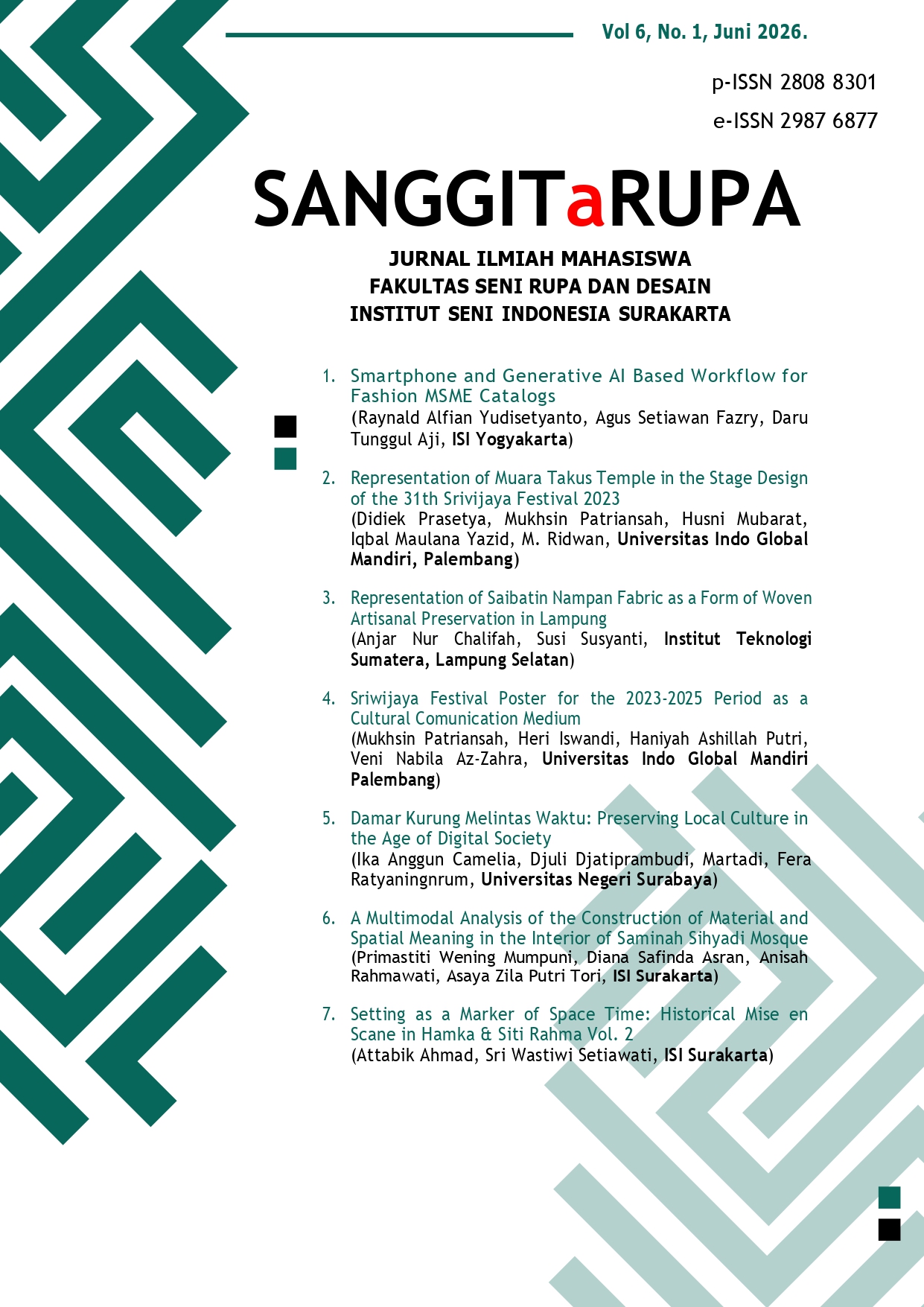
A Multimodal Analysis of the Construction of Material and Spatial Meaning in the Interior of Saminah Sihyadi Mosque
Abstract
Mosques are not merely places of worship; they also serve as complex cultural texts where spatial design and material elements express layered social and symbolic meanings. This study investigates how the interior of Masjid Saminah Sihyadi, an urban mosque in Surakarta, Indonesia, constructs meaning through its material configuration, spatial zoning, and symbolic elements. Using a Multimodal Discourse Analysis (MDA) approach, the research focuses on materials such as rattan and open-cell metal ceilings, pivoted krepyak windows, and copper calligraphy panels. Data were collected through visual documentation, on-site observation, and informal interviews with mosque users. The findings reveal a nuanced narrative embedded in material choices: rattan signifies warmth and intimacy, typically associated with female prayer zones, while exposed metal reinforces spatial dominance and masculine order. The pivot windows mediate openness and social fluidity, and the copper calligraphy marks spiritual authority and sacred presence. These material-spatial arrangements actively participate in shaping religious experience, gendered spatial perception, and socio-cultural narratives. This research contributes to a deeper understanding of interior architecture in religious spaces, highlighting how design operates as an agent of cultural meaning-making.
Downloads
Downloads
Published
Issue
Section
License
Authors who publish with Sanggitarupa agree to the following terms:
- Authors retain copyright and grant the journal right of first publication with the work simultaneously licensed under a Creative Commons Attribution License (CC BY-SA 4.0) that allows others to share the work with an acknowledgment of the work's authorship and initial publication in this journal.
- Authors are able to enter into separate, additional contractual arrangements for the non-exclusive distribution of the journal's published version of the work (e.g., post it to an institutional repository or publish it in a book), with an acknowledgment of its initial publication in this journal.
- Authors are permitted and encouraged to post their work online (e.g., in institutional repositories or on their website) prior to and during the submission process, as it can lead to productive exchanges, as well as earlier and greater citation of published work.

This work is licensed under a Creative Commons Attribution-ShareAlike 4.0 International License.