The Soundmark of Tradition Communicative Functions of Pentatonic Music in the Gula Gending Street Trade of West Nusa Tenggara
Article Sidebar
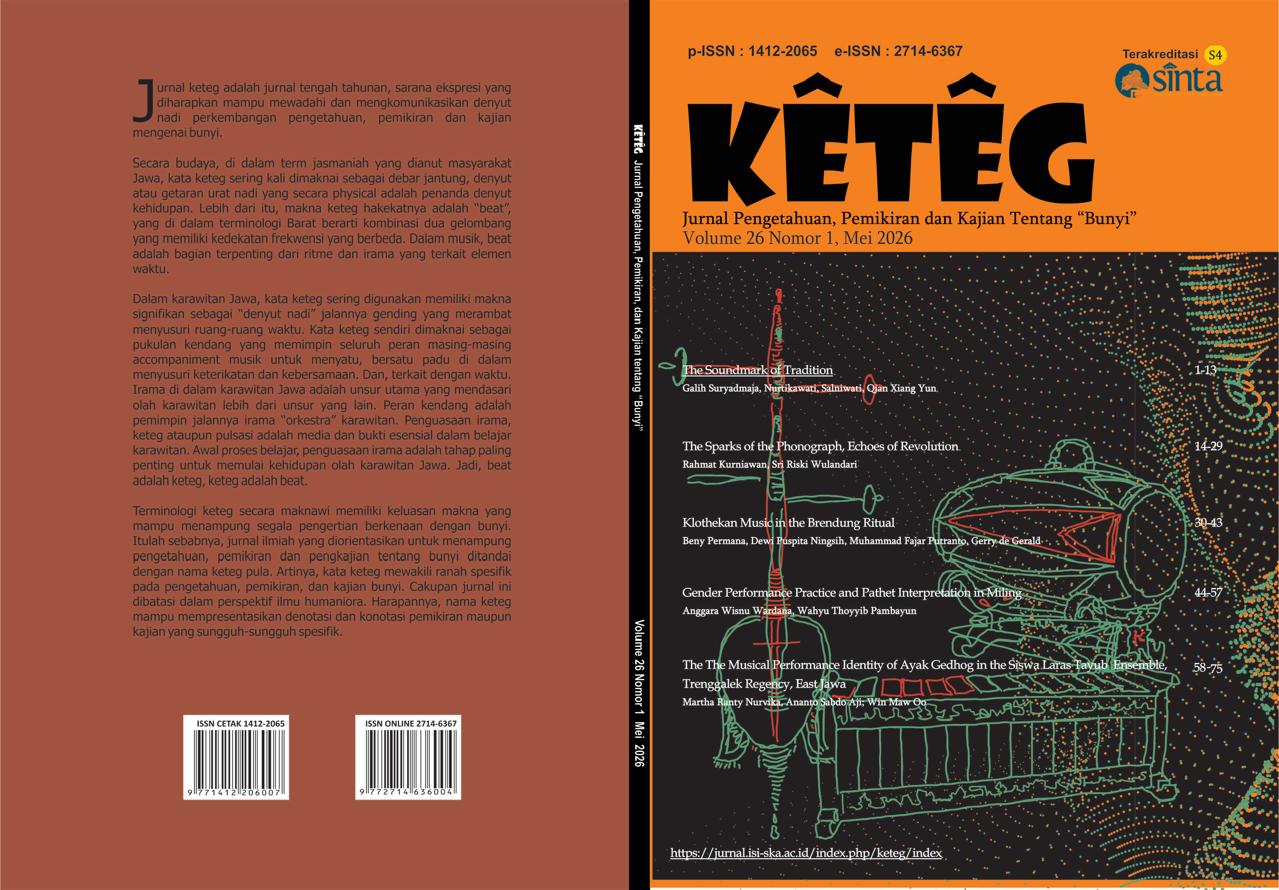
Main Article Content
Abstract
This study investigates the communicative functions of pentatonic music in the Gula Gending street vending practice in West Nusa Tenggara, Indonesia, positioning it as a culturally embedded soundmark within everyday economic activity. While previous soundscape scholarship has largely foregrounded environmental listening, relatively little attention has been paid to the ways in which structured musical systems function as active communicative agents in informal economic contexts. Adopting an ethnomusicological ethnographic approach, this research integrates participant observation, in-depth interviews, and audio-visual documentation to examine the intersections between musical structure, performance practice, and socio-cultural context.
The findings demonstrate that Gula Gending music operates as a multi-layered communicative system: it serves as an auditory marker of identity, a mechanism for attracting attention, a medium for transmitting cultural memory, and a facilitator of social interaction between vendors and consumers. The deployment of pentatonic structures enhances perceptual accessibility, enabling rapid recognition and response within fluid and dynamic street environments. Beyond its functional dimension, the music embodies symbolic meanings that link individual experience to broader collective cultural identities. This study contributes to ethnomusicology and sound studies by reconceptualizing the notion of soundmark as an active semiotic and economic practice rather than a passive acoustic phenomenon. Furthermore, it highlights the capacity of traditional musical forms to operate as adaptive communicative strategies within contemporary informal economies, offering critical implications for cultural sustainability and policy formulation.
Downloads
Article Details

This work is licensed under a Creative Commons Attribution-ShareAlike 4.0 International License.
References
Barley, N. (1995). The Giriama and their songs. Cambridge University Press.
Barz, G., & Cooley, T. J. (Eds.). (2008). Shadows in the field: New perspectives for fieldwork in ethnomusicology (2nd ed.). Oxford University Press.
Becker, J. (2010). Exploring Indonesian gamelan music. Ethnomusicology Forum, 19(1), 87–106. https://doi.org/10.1080/17411911003670455
Erlmann, V. (Ed.). (1997). Music, modernity, and the global imagination. Oxford University Press.
Erlmann, V. (2004). But what of the ethnographic ear? Anthropology, sound, and the senses. American Ethnologist, 31(4), 469–471. https://doi.org/10.1525/ae.2004.31.4.469
Feld, S. (2012). Sound and sentiment: Birds, weeping, poetics, and song in Kaluli expression (3rd ed.). Duke University Press. https://doi.org/10.1515/9780822395447
Gill, K. Z., & Purves, D. (2009). A biological rationale for musical scales. PLOS ONE, 4(12), e8144. https://doi.org/10.1371/journal.pone.0008144
Harnish, D. (2007). Teater rakyat and the modern Indonesian nation: Music, drama, and cultural resilience. Asian Music, 38(1), 1–24. https://doi.org/10.1353/amu.2007.0022
Hartono, D. B. S. (2022). Gula gending di Lombok Timur. Kepel Press; Balai Pelestarian Nilai Budaya Bali. Katalog National Library of Australia. Diakses dari https://catalogue.nla.gov.au/catalog/8820062
Iwamiya, S. (2006). Soundscape: Concept and evolution. Journal of Music Perception and Cognition, 12(1), 49–54. https://doi.org/10.32199/jsmpc.12.1_49
Johánek, F. (2024). The legacy of R. Murray Schafer: Twenty-four hours of soundscape measurements. Musicologica Brunensia, 59(1), 49–70. https://doi.org/10.5817/MB2024-1-4
Kartomi, M. (1990). On concepts and classifications of musical instruments. University of Chicago Press.
Keeler, W. (2017). Traffic in culture: Soundmarks of Myanmar street vendors. Ethnomusicology Forum, 26(3), 345–366. https://doi.org/10.1080/17411912.2017.1378769
Kesumasari, D. (2020). Understanding physical settings of street vendors in Surakarta, Indonesia. IOP Conference Series: Earth and Environmental Science, 490, 012002. https://doi.org/10.1088/1755-1315/490/1/012002
Merriam, A. P. (1964). The anthropology of music. Northwestern University Press.
Mitullah, W., Njoroge, P., & Owuor, S. (2021). The street is ours: Street trading, Covid-19 and new street geographies in Harare, Zimbabwe and Kisumu, Kenya. Food Security, 13, 1263–1281. https://doi.org/10.1007/s12571-021-01162-y
Nettl, B. (2015). The study of ethnomusicology: Thirty-three discussions. University of Illinois Press.
Prajawati, Y. T. (2022). The existence of Kembang Sembah dance as welcoming dance: Music and instruments in Sasak tradition. Advances in Social Science, Education and Humanities Research, 640, 350–355. Atlantis Press. https://www.atlantis-press.com/article/125982483.pdf
Racaud, S., Kago, J., & Owuor, S. (2018). Contested street: Informal street vending and its contradictions. Journal of Urban Research, 18(1). https://doi.org/10.4000/articulo.3719
Rice, T. (2014). Ethnomusicology: A very short introduction. Oxford University Press.
Rosendahl, S. (2018). Street rhythms and the revolution: Cuba’s pregón as cultural soundmark. Journal of Extreme Anthropology, 2(1), 1–21. https://doi.org/10.5617/jea.6466
Samuels, D. (2004). Putting a song on top of it: Expression and identity on the San Carlos Apache Reservation. Ethnomusicology, 48(3), 433–459. https://doi.org/10.2307/20174334
Schafer, R. M. (1994). The soundscape: Our sonic environment and the tuning of the world. Destiny Books.
Seeger, A. (2004). Traditional music in community life. Cultural Survival Quarterly, 28(2). https://www.culturalsurvival.org/publications/cultural-survival-quarterly/traditional-music-community-life
Shelemay, K. K. (2015). Soundscapes: Exploring music in a changing world. W. W. Norton.
Stokes, M. (Ed.). (1994). Ethnicity, identity and music: The musical construction of place. Berg.
Suryadmaja, G., & Ningsih, D. P. (2024, December). Ngringkes: Garap's Adaptation on Jemblungan Music. In Proceedings of the International Music and Performing Arts Conference (Vol. 2, pp. 76-85). https://doi.org/10.37134/impac.v2.8.2024
Suryadmaja, G. (2025). Semiotic Analysis of John Fiske: The Meaning of the Song" Senja Kala Itu" by Gading Suryadmaja. 5 (03), 325–335.
Suryadmaja, G., & Saearani, M. F. T. (2025). Studi estetika seni pertunjukan di era global. Cantata Deo: Jurnal Musik dan Seni, 3(1), 71-86. https://doi.org/10.69748/jmcd.v3i1.339
Sutton, R. A. (2016). Musical interaction in Java and Bali. Asian Music, 47(2), 3–28. https://doi.org/10.1353/amu.2016.0022
Titon, J. T. (2009). Economy, ecology, and music: An introduction. The World of Music, 51(1), 5–15. [suspicious link removed]
Triyanuartha, I. N. (2015). Eksistensi gula gending di dalam dinamika budaya yang terjadi di Lombok. JOUSA (Jurnal Seni). Institut Seni Indonesia. Diakses dari https://journal.isi.ac.id/index.php/JOUSA/article/view/1445
Turner, S. (2015). Itinerant livelihoods: Street vending-scapes and the politics of mobility in upland socialist Vietnam. Singapore Journal of Tropical Geography, 36(3), 394–410. https://doi.org/10.1111/sjtg.12114
Wahyuni, S. (2022). Gula gending dalam sudut pandang budaya dan perannya dalam komunitas lokal. Jurnal Manajemen Budaya. Sekolah Tinggi Agama Islam Driyarkara. Diakses dari https://journal.staidk.ac.id/index.php/manajemenbudaya/article/view/262
Wong, D. (2001). Sounding the center: History and aesthetics in Thai Buddhist performance. University of Chicago Press.
Wong, D. (2019). Listening across boundaries: Ethnomusicology and sound studies. Journal of Sonic Studies, 16. https://www.researchcatalogue.net/view/567890/567891
Yampolsky, P. (2010). Music and media in the Indonesian archipelago. Yearbook for Traditional Music, 42, 1–16. https://doi.org/10.1017/S0740155800004025
Yudarta, I. G. (2017). Kecimol music as cultural identification of Sasak ethnic. MUDRA: Journal of Art and Culture, 32(3), 314–318. Diakses dari https://media.neliti.com/media/publications/195219-EN-kecimol-music-as-cultural-identification.pdf