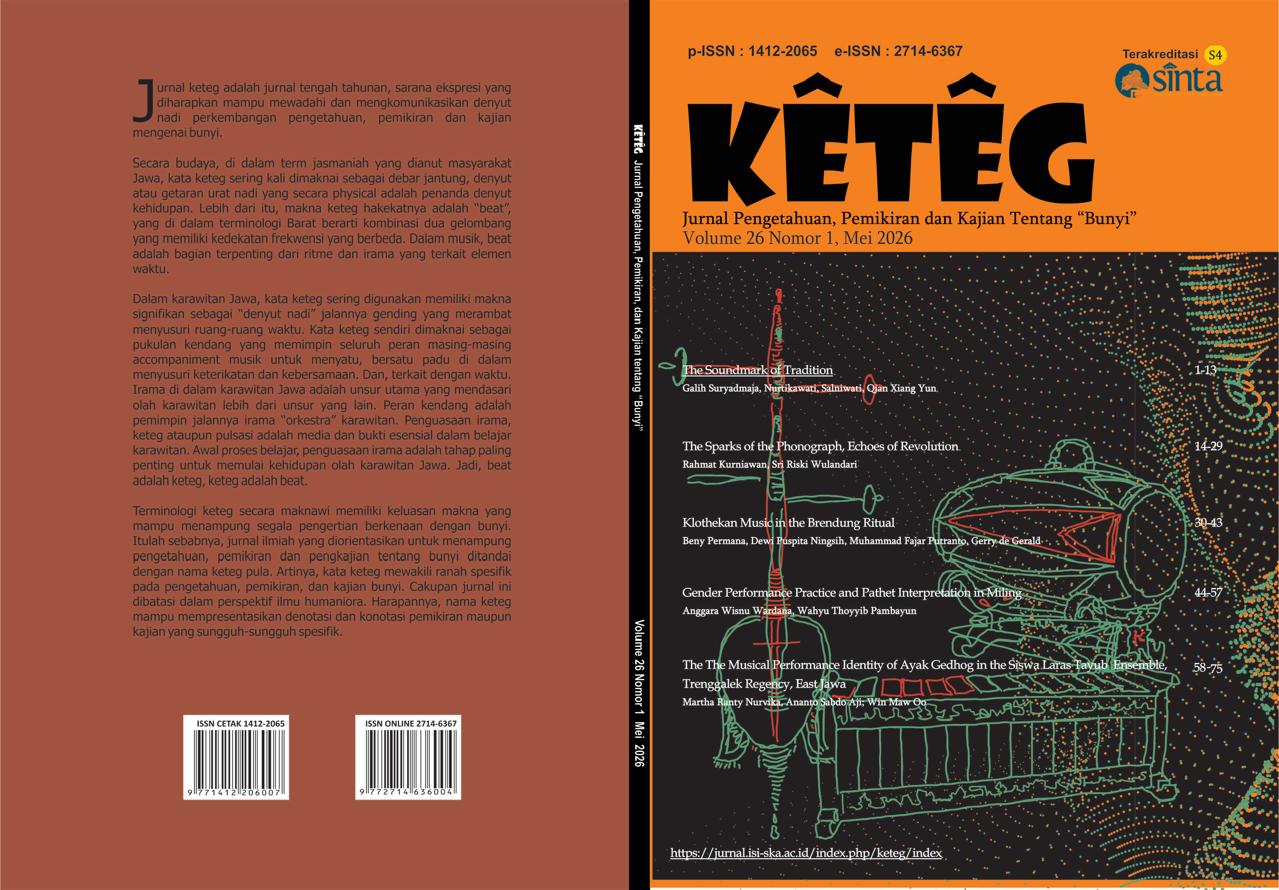
The Sparks of the Phonograph, Echoes of Revolution Béla Bartók and the Birth of Modern Ethnomusicology as a Scholarly Discipline
Article Sidebar
Main Article Content
Abstract
Folk music in nineteenth-century Europe was frequently perceived in a romanticized manner as a symbol of national identity, thereby obscuring a scholarly understanding of its authentic traditions. This article aims to examine the central role of Béla Bartók in establishing the foundational principles of modern ethnomusicology, with particular focus on his use of the phonograph as a revolutionary instrument in folk music research. The study employs a qualitative approach grounded in historical and descriptive-analytical literature review, synthesizing Bartók's own primary writings with secondary sources drawn from a range of academic musicological studies. The findings demonstrate that the phonograph enabled Bartók to conduct objective field recordings, execute microscopically precise transcriptions, and systematically classify melodic materials, while simultaneously correcting prevalent misconceptions between authentic Hungarian peasant music and the so-called style hongrois. Bartók's ethnomusicological discoveries not only forged a new scientific methodology for the cross-cultural study of music, but also fundamentally transformed his compositional practice through an organic synthesis of folkloric elements and twentieth-century modernism. The study concludes that Bartók's contributions marked a fundamental paradigm shift in the way the world perceived folk music from an object of romanticization to a subject of rigorous scholarly inquiry leaving a methodological legacy that remains relevant to contemporary ethnomusicology
Downloads
Article Details

This work is licensed under a Creative Commons Attribution-ShareAlike 4.0 International License.
References
Antokoletz, E. (1984). The_Music_of_Bela_Bartok. University of California Press.
Balan, M. A. , & D. V. L. (2024). RUral Echoes in Classical Music. Lucrari de Muzicologie, 26(2), 3.
Bayles, Martha. (2005). The Strange career of Folk Music. Michigan Quaterly Review., XLIV(2).
Bayley, A. (2001). The Cambridge Companion to Bartók. Cambridge University Press. https://books.google.co.id/books?id=7GIgAwAAQBAJ
Bellman, J. (1993). The Style Hongrois in the Music of Western Europe. Northeastern University Press. .
Borio, G. (2022). Adoption and Transformation of Traditional Forms in the Fourth String Quartet of Béla Bartók. Studia Musicologica, 62(3–4), 277–290. https://doi.org/10.1556/6.2021.00018
Brady, E. (1999). A Spiral Way: How the Phonograph Changed Ethnography. University Press of Mississippi. https://books.google.co.id/books?id=ehL2YNdWeXMC
Bruggeman, D. J. (2013). Béla Bartók and the Natural Interpretation of Music. https://api.semanticscholar.org/CorpusID:55522810
Gillies, M. (2001). Bela Bartok (1881-1945). . Music of the Twentieth-Century Avant-Garde: A Biocritical Sourcebook.
Gollin, E. (2007). On Bartok’s Comparative Musicology as a Resource for Bart?kian Analysis. https://about.jstor.org/terms
Hernon, Michael. (2023). Bela Bartoks History. EBSCO: Research Starters.
Hooker, L. M. (2014). Redefining Hungarian music from Liszt to Bartok. Choice Reviews Online, 51(12), 51-6657-51–6657. https://doi.org/10.5860/CHOICE.51-6657
Hooker, L. M. (2019). Music Criticism in Hungary until the Second World War. The Cambridge History of Music Criticism. https://api.semanticscholar.org/CorpusID:202364945
Kealiinohomoku, J. W. (2015). Johann Gottfied von herde and the idea of the folk. Britanica.
Kirk, J. (2013). Bartok’s Monster. Harper’s Magazine.
Kodály, Z. (1971). Folk Music of Hungary (R. Tempest & C. Jolly, Trans.; Edisi revisi dan diperbesar oleh L. Vargyas). Barrie and Jenkins.
Mayes, Cathrine. (2014). Eastern European National Music as Concept and Commodity at the Turn of the Nineteenth Century. . Oxford University Press. .
Myers, H. (1992). Ethnomusicology: An Introduction. Macmillan. .
Nelson, D. (2012). Béla Bartók: The Father of Ethnomusicology. Musical Offerings, 3(2), 75–91. https://doi.org/10.15385/jmo.2012.3.2.2
Peker, R. P. , & B. S. (2024). An Analisys of Bela Bartoks Comparasions ond the Similiralities Between Turkish and Hungarian Music Through Three Works. Online Journal of Music Sciences. , 2(2).
Reed, D. J. (2007). The Study of Ethnomusicology: Thirty-One Issues and Concepts. Journal of Folklore Research Reviews. https://api.semanticscholar.org/CorpusID:262697238
Sakarya, U. C. (2025). The Creation Of Amodernist Style From Folk Music Sources: Bela Bartoks Polymodal Chromaticsm. . Eurasian Jurnal Music and Dance.
Schneider, D. E. (2006). Bartok, Hungary, and the Renewal of Tradition: Case Studies in the Intersection of Modernity and Nationality. University of California Press. .
Somfai, L. (1996). Bela Bartok : Composition, Concepts, and Autograph Sources. . University of California Press. .
Taylor, M. N. (2008). Does Folk Dancing Make Hungarians? Tanchas, Folk Dance as Mother Tongue, and Folk Dance Cultivation. Hungarian Studies. .
Vikárius, L. (2016). Bela Bartok ’s Correspondence. ARNO: Rivista Di Studi Musicali e Musicologici Dell’Archivio Zeta, 1(1), 45–60.
Yoshida, Hiroshi. (2020). Johann Gottfried Herder’s Folksong Project as a Pioneering Involvement in Intangible Cultural Heritage: Between Universalism and Nationalism. . JTLA: University of Tokyo.